W3C reference (context only, see #200)
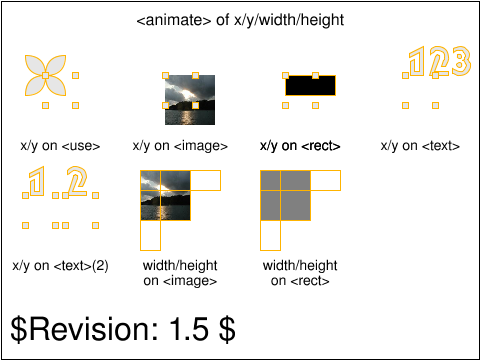
Foxglove
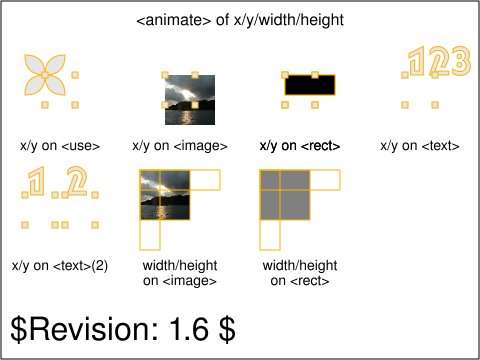
Difference
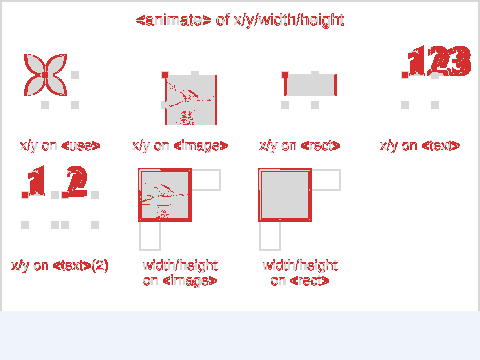
<text id="revision"> legend every test carries: it renders in a fallback font this
library cannot match, so it is excluded from the comparison entirely rather than failing every test.
Over the course of four seconds, the positions and sizes of elements within the document are animated. The test passes if the following conditions are met: In the first four subtests, the shape, image or text moves clockwise once along the perimeter of a square whose corners are indicated by the small grey squares. In the fifth subtest ("x/y on <text>(2)"), the number "1" moves clockwise along the perimeter of a square as in the first four subtests, while the number "2" does the same except in an anti-clockise direction. In the sixth subtest, the width and height of the image are animated continously, from the initial square size, to the wide and short rectangle, to the narrow and tall rectangle, and back to the square. At each point when it reaches one of these key sizes, the yellow outline indicating the size is shown thicker momentarily. This animation takes only three seconds. In the seventh subtest, the gray rectangle's width and height are animated in the same way as the image in the sixth subtest.
