W3C reference (context only, see #200)
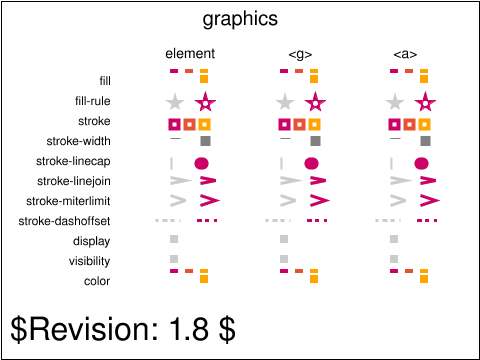
Foxglove
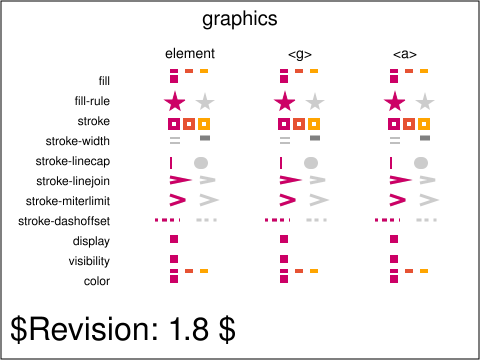
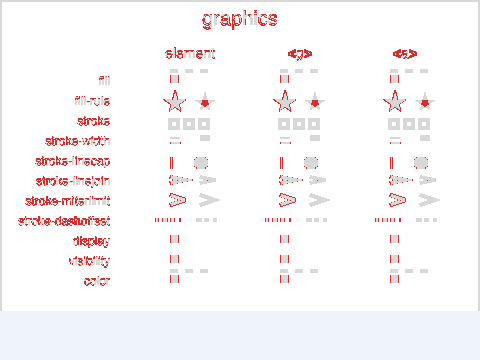
Difference
<text id="revision"> legend every test carries: it renders in a fallback font this
library cannot match, so it is excluded from the comparison entirely rather than failing every test.
There are 11 graphics properties that are animated, and for each of these, they are animated in one of three different ways (the three columns). The three animations in each row must be the same. For each animation test, the element on which the animation is applied is also translated by an animation so that the various states of the animation can be checked more easily: For those tests that have two light gray silhouettes (fill-rule, stroke-linecap, stroke-linejoin, stroke-miterlimit and stroke-dashoffset), the animated element's shape must be the same as the left silouhette at the start of the animation and the same as the right silhouette at the end of the animation. For the continous paint animations (fill, stroke and color), three references shapes show the color that the animated element must be at the start, middle and end of the animation. For the stroke-width test, the two dark gray reference shapes show the width of the short, animated horizontal line must be at the start and the end of the animation. For the display and visibility tests, the single light gray silhouette shows the position the animated element must be at at the start of the animation. At the end of the animation, these animated elements must not be visible. The following animations must show continuous changes: fill, stroke, stroke-width, stroke-dashoffset and color. The following animations must show discrete animation changes: fill-rule, stroke-linecap, stroke-linejoin, stroke-miterlimit, display and visibility. The point at which the change takes place must be half way through the animation, except for the stroke-miter animation, which must change a quarter of the way through. (Note that visually, stroke-miterlimit shows a sharp transition even though its value is animated continuously, but that is because the miter is cut off when the animated miter limit reaches the test sharp angle's miter value.) The test passes if all of the above criteria are met.
